No Flooding
No forcing your dog into full panic.
Instant online access • Start today • 30-day money-back guarantee
The Home Alone Method™
A clear, structured programme that helps you identify the real problem, know when to progress, and recover from setbacks, whether this is your first attempt or your fifth.
You are not dealing with an unusual dog. While leading research found that 8 out of 10 dogs struggle when alone, separation-related distress is a common reality for dogs everywhere.

Secure checkout. Instant digital access.
30-day money-back guarantee · Card & PayPal accepted · SSL encrypted
Built around international veterinary and behaviour guidance.
Full sources included.
THE PROBLEM

It starts before you even touch the door handle. You're getting dressed for work, and your dog is already pacing. Their eyes are locked on you. Their breathing is getting faster. You haven't even picked up your keys yet, but they already know what's coming.
You try to leave quietly. Shoes on in the hallway, no eye contact. It doesn't matter. The second the door closes, the barking starts. Not just barking. Screaming. The kind of desperate, guttural howling that makes your stomach drop. You stand on the other side of the door, frozen, wondering if you should go back in.
And then the guilt hits. You check your phone obsessively. You cut every outing short. And when you get home, you find out why: scratched doorframes, chewed skirting boards, a puddle of drool by the window.
Your life has shrunk. You don't go out for dinner anymore. You turn down invitations. You have rearranged your entire schedule around a dog who cannot be left alone for twenty minutes. And the worst part? You love this dog more than anything. You'd do anything for them. But it leaves owners feeling exhausted, frustrated, and completely trapped in their own homes.
WHAT IS ACTUALLY HAPPENING
Your dog is not just reacting to you walking out. They are reacting to every signal that predicts it: picking up keys, putting on shoes, grabbing your bag. By the time you reach the door, they are already in full panic mode. And that panic does not come back down.

Illustrative chart for educational purposes. Results vary by dog.
Notice what the chart does not show: a return to calm. Once panic peaks, it stays high for the whole absence. This is why a longer absence does not teach a dog to settle.
THE CYCLE
Every time you rush home or avoid leaving, the anxiety gets stronger. The cycle repeats, and it never fixes itself.

Illustrative cycle for educational purposes. Results vary by dog.
THE COST OF WAITING
Separation anxiety does not stay the same. It gets worse. The barking that used to last ten minutes now lasts an hour. The scratching at the door has become gouging. The neighbours who used to be understanding are now leaving notes, or calling your landlord.
Some owners reach a breaking point. They are not "bad" owners. They are exhausted people who never found the right help at the right time.
WHY IT HAS NOT WORKED
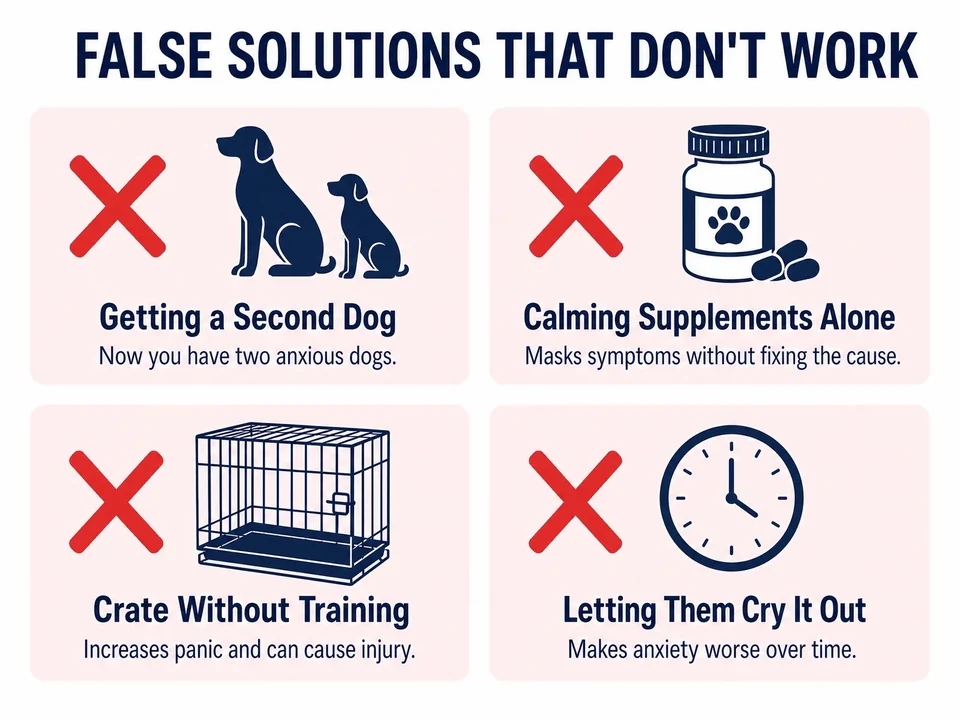
None of these fix the root cause. Some of them actually make it worse.

This programme is not based on opinion. It follows systematic desensitisation, the approach with the strongest support in the veterinary behaviour literature for separation-related problems.
That means:
No forcing your dog into full panic.
The programme never uses punishment.
No leaving your dog to panic alone.
Progress at your dog’s own pace.
The RSPCA is explicit that leaving a dog to cry it out is harmful. This programme never asks you to do that. Every claim is sourced, with guidance drawn from the ASPCA, the RSPCA, the American Veterinary Society of Animal Behavior and peer-reviewed veterinary research.
A self-guided programme, not a substitute for individual veterinary or behavioural advice. If your dog shows aggression or needs support beyond a self-guided programme, please consult a vet or qualified behaviourist.
THE OUTCOME

Imagine walking to the front door and your dog barely lifts their head from the sofa. No pacing. No whimpering. Just a calm glance that says, "See you later."
Imagine walking out without that knot in your stomach. No guilt, no dread, no standing on the doorstep listening for barking. Just leaving.
Imagine coming home and finding your dog relaxed on their bed. No destruction, no puddles, no frantic jumping. Happy to see you, but calm while you were gone.
Imagine saying yes to dinner with friends, or a spontaneous coffee run, without constant clock-watching.
That is the goal you are working towards. Not overnight, and not according to a fixed timetable, but gradually as your dog builds confidence at their own pace.
SUITABILITY
This is for you if:
This is not for you if:
WHAT IS INCLUDED
One complete, structured digital playbook hosted on Notion. It works like a private, beautifully organised website built specifically for your phone, tablet, or computer. Because it lives online rather than as a static file, it stays current, and every single update reaches you automatically.
No app to download and no password to remember. Just click a secure link and start today.
No scrolling through clunky PDFs. Click on the phase you need and it expands with clear steps.
Pop open the Morning Checklist or the Trigger Reset Protocol right on your screen while you work.
A structured, text-and-visual method you can read in minutes. No long videos to sit through.
THE COMPLETE PROGRAMME
The Home Alone Method™ is built around the Duration Ladder—the core six-phase progression—with every tool you need to handle real-world challenges built right in.
It answers the three questions where most owners get stuck:
Here is how the method handles every stage of your dog's progress:
A structured, phase-by-phase progression that builds calm alone time from seconds to hours, at your dog’s pace.
The exact low-drama way to leave and return, so your exits stop feeling like a big event to your dog.
Breaks the link between keys, shoes and coat and panic, so departure cues stop triggering a reaction before you even leave. Only some dogs need this one.
Most methods tell you to progress at your dog’s pace without telling you how to know what that pace is. This is a simple, objective check that answers it.
You reach eighteen minutes, have one bad day, and drop back to five. This is the specific response that helps you recover without abandoning training.
What to do on the days you must be out longer than your dog is ready for, so one unavoidable absence does not undo your work.
A quick way to log every session, so you can see progress building even on days when it does not feel like it.
ALSO INCLUDED
Helpful extras that make the method easier to follow. Not more things to learn, just support.
Five well-intentioned habits, like comforting your dog before leaving or sneaking out, that can make separation anxiety worse, and what to do instead.
A varied rotation of long-lasting chews, frozen food toys, puzzle feeders and scatter games, with practical safety guidance.
Secure checkout. Instant digital access.
HONEST EXPECTATIONS
Separation anxiety is not solved in a weekend, and anyone who tells you otherwise is selling you something they cannot deliver.
Your dog is not being difficult. They have learned that being alone is dangerous, and that learning is undone the same way it was built: gradually, in small steps, with enough repetition that the new lesson sticks.
Some dogs move quickly through the early phases. Others take weeks on Phase 1. Both are normal, and the programme tells you how to tell which one you have.
And what you get is not speed... It is a clear next step, every single day, and a plan for the days it goes wrong.
THE METHOD
The heart of the programme is the Duration Ladder, six phases that gradually build your dog's calm alone time. You start small and build up gradually. No flooding. No forcing. Just steady progress at your dog's pace.
Build calm at the front door
Build calm through brief out-of-sight moments
Build from 1–5 minutes alone
Work gradually towards 30 calm minutes
Extend into real-world absences
Build towards
2–4 hours alone
Phase 6 builds towards 2–4 hours alone—the maximum recommended by leading welfare organizations like the RSPCA for a dog's mental and physical well-being. Beyond the six phases, the programme covers welfare guidance and cover arrangements for longer absences.
You establish which problem you are solving. About five minutes.
If your dog reacts to your departure cues, you pick up your keys and put them back down again. If they do not, you skip that stage entirely and start at the door.
Around 10 minutes of active training, split across two short sessions.
The first thing most owners notice is not a longer absence but a change in the run-up: your dog lifting their head instead of leaping up, or following you to the door without starting to pant. Those small shifts usually come before the clock moves, and they are the genuine early sign this is working.
WHAT HAPPENS NEXT
Get instant access
As soon as your purchase is complete, you'll be able to access The Home Alone Method™ online programme straight away. We'll also send the access link to your email so you can easily return to it anytime.
Open the online programme
Access the complete method on your phone, tablet or computer. No account or app is required. Your built-in digital tools are available inside the programme.
Start with Start Here
Begin with the Start Here page. It takes you through four short steps and ends with your first exercise the same day. The rest of the programme is reference material you open when you need it, not reading to get through first.
Start your first exercise today
Begin with the first small exercise and build from there gradually, following your dog’s response rather than rushing towards a fixed timetable.
Secure checkout. Instant digital access.
THE COMPARISON
In a survey of over 1,000 pet owners, those dealing with separation anxiety reported spending an average of
$330 a year
on it: supplements, daycare, replaced door frames, cancelled plans. Most of that money manages the symptoms rather than resolving the cause.
Professional separation anxiety programmes run from hundreds into thousands, and one-to-one trainers typically charge $80 to $200 a session.
The Home Alone Method gives you a complete, structured desensitisation system: from the earliest departure triggers to gradually building calmer, more confident alone time. All for $47. Less than a single session with a trainer. Less than one chewed-up pair of shoes.
“I priced this at $47 because every dog owner deserves the complete solution, not just those who can afford expensive professional programmes. That is the whole reason it exists at this price.” — Sheila, Founder, The Home Alone Method™
Upon completing your purchase, you will receive immediate access to The Home Alone Method™ online programme, so you can begin your first exercise today.
Your purchase is protected by a 30-Day Money-Back Guarantee. If you find that the method isn't the right fit for your situation, simply email support@thehomealonemethod.com within 30 days of purchase and I will issue a full refund of your $47 purchase price.
Every dog will progress at their own pace. The aim is steady, gradual progress as you work through the method consistently, without rushing your dog or forcing them beyond what they can comfortably handle.
Secure checkout. Instant digital access.
QUESTIONS
You get immediate access to The Home Alone Method™ digital playbook hosted on Notion. It works like a private, beautifully organised website right in your phone's browser.
No Accounts: No apps to download and no passwords to remember.
Integrated Digital Tools: Includes a Daily Progress Tracker, Weekly Schedule Planner, Morning Checklist, and Enrichment Planner built right into the pages.
No Clunky Paper: The worksheets are fully integrated digital frameworks you can view and use right on your phone or screen.
Automatic Updates: Any future improvements or corrections reach you instantly at no extra cost.
This is critical. Five different problems, separation distress, boredom, noise sensitivity, confinement frustration, and incomplete house training, produce almost identical behaviors. Four of these will not respond to separation training. The Start Here page walks you through a simple 5-minute screening test to ensure you are solving the right problem.
Every dog progresses at a different pace. This issue does not resolve in days. The first change most owners notice is a calmer reaction to departure cues like picking up keys or putting on shoes. Building the confidence to stay home alone for hours takes longer. The program is built to measure your actual stage rather than force you against a strict timetable.
Yes. The exercises begin with very short separations and progress according to your individual dog's responses.
Puppies: The focus is on teaching them that short periods alone are safe. Young puppies have different developmental and toileting needs, so long-duration stages are not intended for them.
Rescues & Seniors: They can work through the method at their own pace. Some may need more time in the early phases depending on their history.
Free advice gives you random pieces with no structure. This program gives you a complete, step-by-step system with daily exercises, clear progression criteria, and emergency protocols.
10 minutes or less. Most exercises take under 5 minutes. Consistency matters far more than duration. Short daily sessions are much more effective than occasional long ones.
This is exactly what the program was built for. The Confidence Checkpoint gives you an objective test to see if your dog is truly ready to progress. The Setback Recovery System tells you exactly how to handle bad days so you do not lose your progress.
The method starts at the front door. We build calm there before ever introducing out-of-sight moments. Severe cases will simply need more time in the early phases. Some dogs may also benefit from support from a vet alongside this training.
Yes. If you have time to make a cup of tea, you have time for this program. You are not doing hour-long drills. You are doing tiny, deliberate actions like stepping outside for 30 seconds and coming back in.
The program uses the exact same desensitisation principles used by professional behaviorists. The only difference is that you are following a structured, self-guided system rather than paying hundreds of dollars for a private coach.
If your dog panics, the current step is too difficult or you moved forward too fast. The program includes a Setback Recovery System and troubleshooting guides to help you adjust your pace.
Give your dog the structure they need to finally feel safe alone.
A complete, structured separation anxiety system, including the readiness test, the setback plan and the real-life contingency that most programmes leave out. $47, in your hands, starting today.
YES, I'M READY - $47Secure checkout. Instant access.